
Looking for Innovation: Challenges, Change, and the Need for Reform within Agri-Food R&D
For complex issues like agricultural R&D, making real progress depends on trust, honest and productive dialogue, and looking beyond individual interests to see the bigger picture. That’s why combining survey evidence with in-depth workshop discussion is so helpful. It gives space for honest, sometimes tough questions about whether the current system is truly fit for the 21st century and how to foster a long-term vision that transcends individual interests.
This approach helps test whether there’s real consensus or just parallel conversations. When stakeholders feel invited to challenge assumptions, listen to each other, and reflect on both local needs and wider priorities, it creates a better starting point for long-term reforms everyone is willing to support.
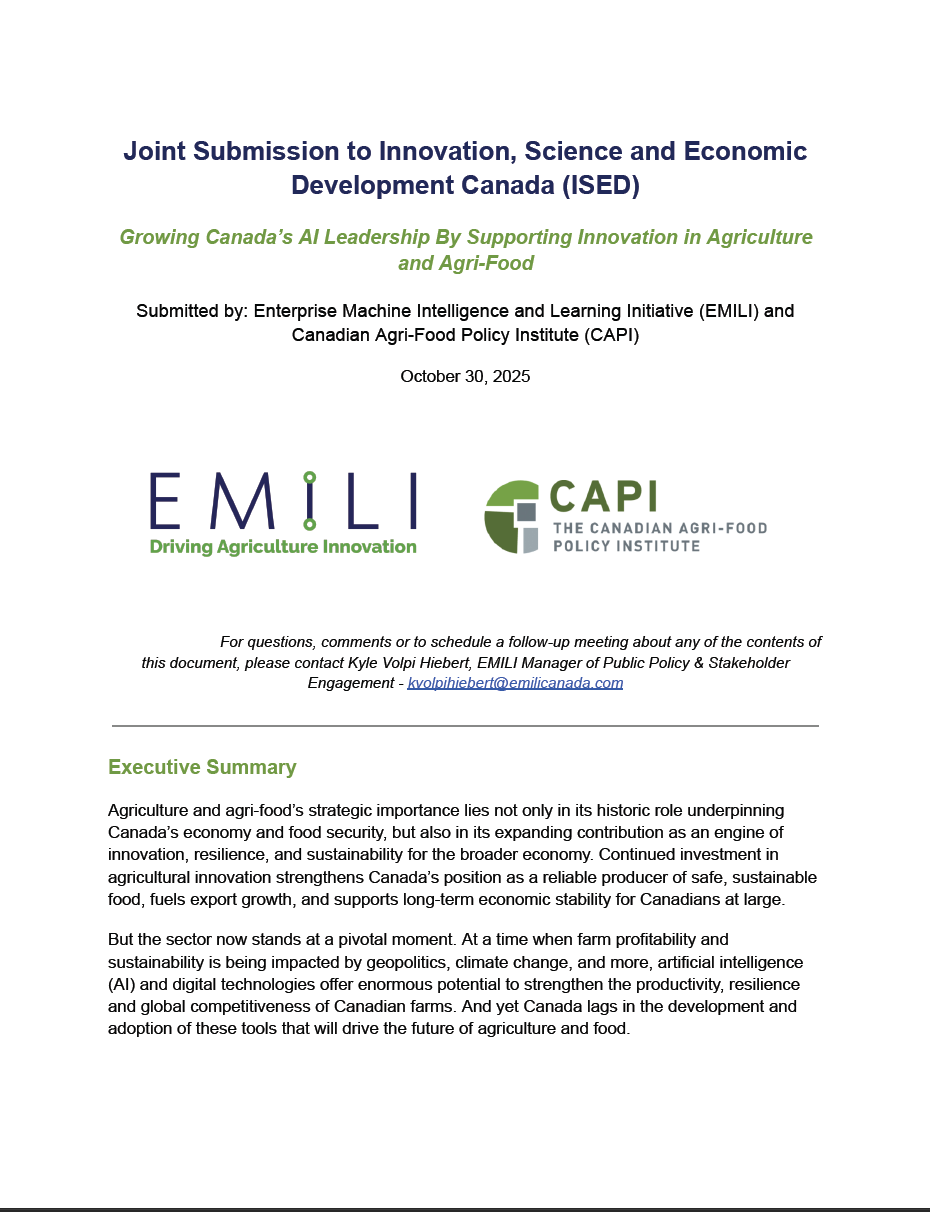
Joint submission to Innovation, Science and Economic Development Canada (ISED)
Growing Canada’s AI Leadership by Supporting Innovation in Agriculture and Agri-Food
As part of ISED’s national engagement on the next Pan-Canadian AI Strategy, Canadian Agri-Food Policy Institute (CAPI) and the Enterprise Machine Intelligence and Learning Initiative (EMILI) submitted joint recommendations to highlight a perspective that has been largely absent in Canada’s AI policy conversation: the role of agriculture as a strategic domain for high-impact, responsible AI adoption.
Digital transformation is reshaping global agriculture, and Canada’s ability to compete, adapt, and lead increasingly depends on how AI is integrated into production systems, supply chains, sustainability practices, and rural economies. The joint CAPI- EMILI submission draws attention to this strategic reality and positions agriculture not as an end-user of AI, but as a sector where AI can generate broad economic, environmental, and social value for the country.
The joint recommendations identify four priority areas that merit attention in the renewed AI Strategy:
- Establish trusted, farmer-centred data and AI governance
Clarity on data rights, transparency requirements, interoperability, and responsible AI practices is foundational to enabling adoption across the agri-food system. - Strengthen commercialization pathways for AI-enabled agricultural innovation.
Targeted mechanisms are needed to connect AI research, startups, and producers, and to support technologies that are ready to scale beyond pilots. - Advance a national digital agriculture skills agenda.
Building AI literacy, technical capacity, and applied training opportunities in rural and agricultural settings is essential for safe and effective deployment. - Treat digital infrastructure as core agricultural infrastructure.
Reliable connectivity, smart-farm testing environments, and modern data systems are prerequisites for integrating AI into production, supply chains, and sustainability practices.
This contribution reflects our shared commitment to positioning digital agriculture as a cornerstone of Canada’s innovation and competitiveness agenda.
Related Resources



Related News

December 2025
Related Events




Funders/Partners