
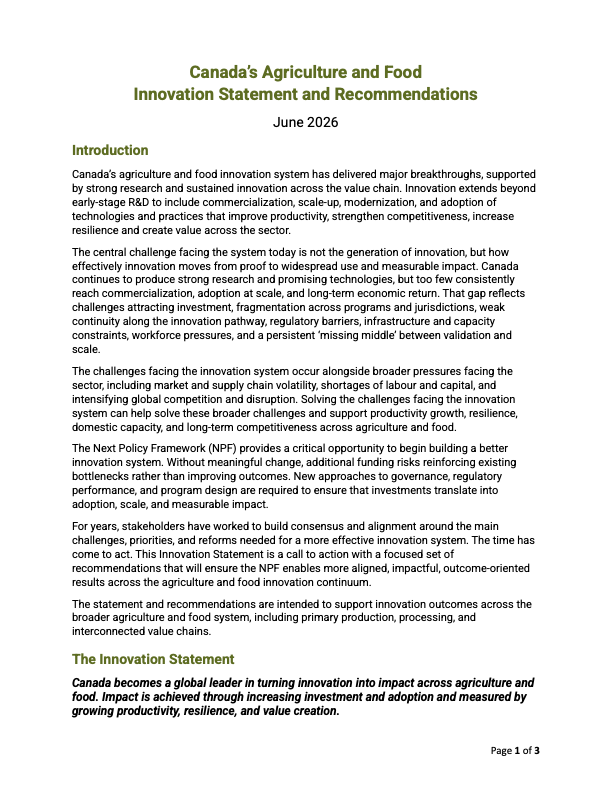
Canada’s Agriculture and Food Innovation Statement and Recommendations
Canada becomes a global leader in turning innovation into impact across agriculture and food. Impact is achieved through increasing investment and adoption and measured by growing productivity, resilience, and value creation.
The innovation statement is underpinned by three recommendations that are changes governments can make in the Next Policy Framework. They aim to support a more aligned discussion and help move the agriculture and food innovation system toward the North Star in a way that is ambitious and achievable.
- Strengthen innovation leadership and prioritization to provide clear direction, stronger alignment, and accountability for results.
- Modernize the regulatory system to improve predictability, transparency, and the conditions for commercialization, adoption, and investment.
- Reform and renew programs to strengthen the path from proof-of-concept to commercialization, modernization, adoption and scale.
Canada’s Agri-Food Innovation Statement and Recommendations: Where the Conversation Stands
Over the past year, CAPI has led a multi-phase initiative to help shape a more coherent and effective agri-food innovation system in Canada. This work has combined system analysis, national stakeholder engagement, dialogue-based testing of emerging ideas, and structured convening across the innovation continuum. The objective has been to build consensus on the main challenges and opportunities facing Canada’s agri-food innovation system, co-develop a practical framework for action, and ground policy direction in evidence, operational realities, and the experience of those working across the sector.
That process has reinforced a consistent message: Canada’s main challenge is not generating innovation, but ensuring it moves through the system and delivers measurable impacts. It has also shown the value of creating space for funders, researchers, industry, and producers to test assumptions, challenge language, and refine priorities together. Stronger policy direction is more likely to hold when it reflects how the system actually works and where it breaks down in practice.
This report reflects one part of that broader CAPI-led initiative. It draws on the February 2026 AgRISE workshop, which focused particularly on commercialization, adoption, and scaling. Its purpose is to capture where the discussion became clearer, where perspectives are converging, and how the Innovation Statement and supporting recommendations were refined through dialogue.

Looking for Innovation: Challenges, Change, and the Need for Reform within Agri-Food R&D
For complex issues like agricultural R&D, making real progress depends on trust, honest and productive dialogue, and looking beyond individual interests to see the bigger picture. That’s why combining survey evidence with in-depth workshop discussion is so helpful. It gives space for honest, sometimes tough questions about whether the current system is truly fit for the 21st century and how to foster a long-term vision that transcends individual interests.
This approach helps test whether there’s real consensus or just parallel conversations. When stakeholders feel invited to challenge assumptions, listen to each other, and reflect on both local needs and wider priorities, it creates a better starting point for long-term reforms everyone is willing to support.
Joint submission to Innovation, Science and Economic Development Canada (ISED)
Growing Canada’s AI Leadership by Supporting Innovation in Agriculture and Agri-Food
As part of ISED’s national engagement on the next Pan-Canadian AI Strategy, Canadian Agri-Food Policy Institute (CAPI) and the Enterprise Machine Intelligence and Learning Initiative (EMILI) submitted joint recommendations to highlight a perspective that has been largely absent in Canada’s AI policy conversation: the role of agriculture as a strategic domain for high-impact, responsible AI adoption.
Digital transformation is reshaping global agriculture, and Canada’s ability to compete, adapt, and lead increasingly depends on how AI is integrated into production systems, supply chains, sustainability practices, and rural economies. The joint CAPI- EMILI submission draws attention to this strategic reality and positions agriculture not as an end-user of AI, but as a sector where AI can generate broad economic, environmental, and social value for the country.
The joint recommendations identify four priority areas that merit attention in the renewed AI Strategy:
- Establish trusted, farmer-centred data and AI governance
Clarity on data rights, transparency requirements, interoperability, and responsible AI practices is foundational to enabling adoption across the agri-food system. - Strengthen commercialization pathways for AI-enabled agricultural innovation.
Targeted mechanisms are needed to connect AI research, startups, and producers, and to support technologies that are ready to scale beyond pilots. - Advance a national digital agriculture skills agenda.
Building AI literacy, technical capacity, and applied training opportunities in rural and agricultural settings is essential for safe and effective deployment. - Treat digital infrastructure as core agricultural infrastructure.
Reliable connectivity, smart-farm testing environments, and modern data systems are prerequisites for integrating AI into production, supply chains, and sustainability practices.
This contribution reflects our shared commitment to positioning digital agriculture as a cornerstone of Canada’s innovation and competitiveness agenda.
Related Resources
At a Turning Point: Canada’s Agricultural R&D
October, 2025

Policy and Practice for Sustainable Agriculture and Trade
December, 2024

Related News

December, 2025
Related Events



Funders/Partners